
A structured facilitation framework for the meetings that actually matter — strategy sessions, project kickoffs, quarterly planning, and every high-stakes conversation in between.
(Gartner)
(Microsoft)
(HBR)
Think about your last difficult meeting. Chances are, it wasn’t that your team lacked ideas. They had plenty. The problem was something else entirely:
This is what we call the Decision Confidence Gap — the space between a room full of smart people and a decision everyone actually commits to. It’s not a personality problem. It’s a structural one.
Three things collapse decision confidence in every meeting:
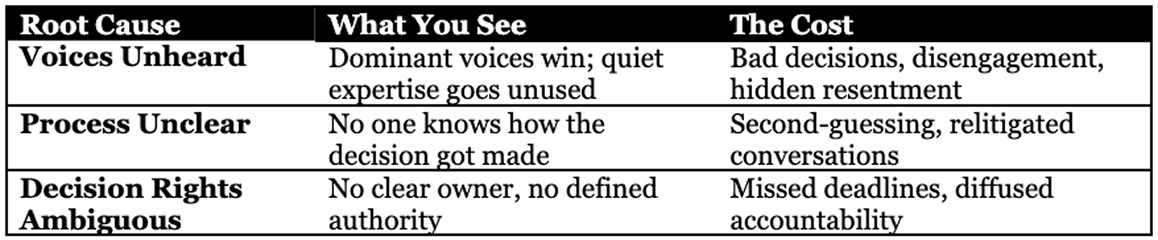
The good news: all three are fixable. With the right structure.

MEET is a four-phase facilitation framework that moves a group from complexity and competing opinions to prioritized action with documented accountability — every time.
MEET was designed for high-stakes sessions — where the usual meeting format just doesn’t cut it.
Map
Before you can solve the right problem, you have to see it clearly. The MAP phase externalizes everything — issues, perspectives, data gaps, competing priorities — out of people’s heads and onto the wall.
Working in silent, individual writing mode (not group discussion), every participant puts their perspective in the open. Inputs get clustered and labeled into themes. For the first time, the room has a shared view of the real problem space.
Hidden agendas, false consensus, the “meeting after the meeting” where real views finally emerge.
A categorized, visual landscape of your full problem space — built in 10–15 minutes, owned by everyone in the room.
Evaluate
Not everything on the wall deserves your attention. The EVALUATE phase narrows the field using structure — not debate.
Anonymous dot voting against a clear criterion (e.g., “If we made progress here in 90 days, which would most increase our ability to deliver?”). Votes reveal collective wisdom without hierarchy distorting the result. The top priorities surface, get named, and become the team’s shared focus.
Analysis paralysis, endless debate, solving symptoms instead of causes, the HiPPO effect (Highest Paid Person’s Opinion).
Top 1–3 clearly framed priorities, with team alignment — not just consensus.
Experiment
Once the focus is clear, it’s time to generate solutions. But not polished solutions — small, testable experiments that can move before the next quarter review.
Silent ideation — each person generates ideas independently before any idea is evaluated. This diverge before converge discipline prevents the first idea from becoming the default and ensures the room’s full creative range surfaces.
Expert dominance, “first idea wins” syndrome, premature judgment, and the tendency to build grand programs when a 60-day test would do.
10 or fewer prioritized solution pathways, plotted on an Impact/Effort Matrix.
Turn Into Action
Great ideas die in follow-up. The TURN INTO ACTION phase makes accountability explicit, not assumed.
The team’s top priorities get mapped to owners, timelines, and decision authority. Every commitment is written down: who owns it, what the first action is within 7 days, who else needs to be in the conversation, and what success looks like.
“Great meeting, no follow-through,” ambiguous ownership, post-meeting confusion, and the erosion of trust that builds when commitments go unmet.
Documented commitments with explicit owners, deadlines, decision rights, and measurable success conditions.
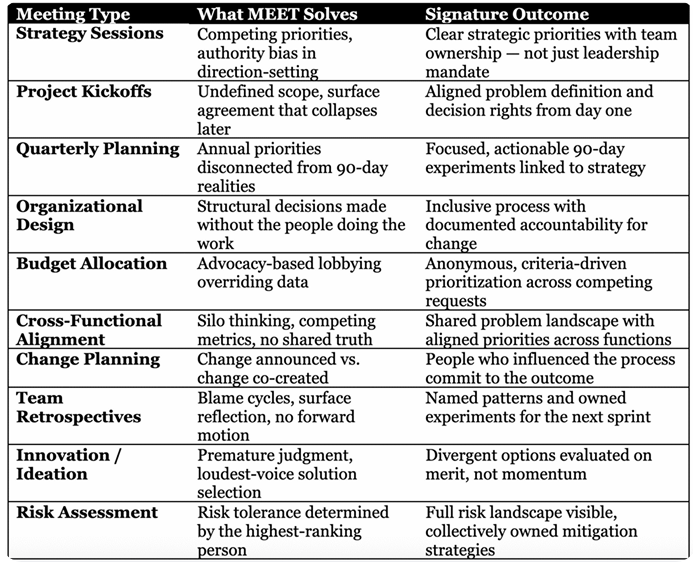
MEET was built for the meetings where the stakes are high enough that a bad process is genuinely costly. Here’s where leaders are using it:
MEET is most powerful wherever the cost of a bad decision — or no decision — is real.
The behaviors MEET is designed to counter are well-documented. Research on organizational decision-making consistently shows that unstructured group discussion amplifies existing hierarchies rather than surfacing collective intelligence.

The HiPPO Effect — where groups defer to the Highest Paid Person’s Opinion — is not just anecdotal. Studies on authority bias, rooted in research dating back to the Milgram experiments, demonstrate that people systematically suppress dissent when a high-status opinion enters the room. One study from the Rotterdam School of Management found that projects led by junior managers had higher success rates — precisely because their teams felt safe enough to offer honest critique.
Groupthink, first described by social psychologist Irving Janis, occurs when the desire for harmony overrides accurate assessment. In consensus-driven settings, diverse perspectives that could improve the decision never surface.
MEET is engineered to counteract both:
The result isn’t slower decisions. It’s decisions that don’t need to be revisited.
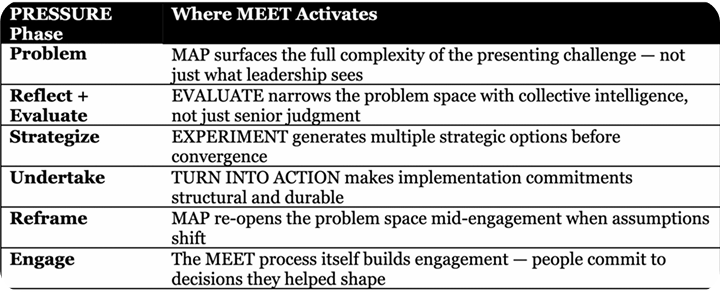
MEET is the meeting-level engine that powers every phase of a PRESSURE engagement.
Double Loop Performance’s PRESSURE methodology — Problem, Reflect, Evaluate, Strategize, Sacrifices, Undertake, Reframe, Engage — provides the macro framework for organizational transformation. MEET ensures that the meetings inside each PRESSURE phase don’t become the bottleneck.
If your organization is working through a PRESSURE engagement, MEET is how you run the rooms.
A Facilitated Session
We design and facilitate a MEET session for your team’s specific challenge — strategy, planning, alignment, or change. One session. Real decisions. Documented accountability.
Fill out the form to download your free copy.
We train your team leads and senior facilitators to run MEET independently. You leave with the capability, the canvas, and the confidence to use it.
Already working with Double Loop on a PRESSURE engagement? MEET is built into every phase. Ask your consultant about expanding facilitation support.
Double Loop Performance helps organizations unlock sustainable growth through sales strategy, organizational transformation, and expert facilitation. Learn more about the PRESSURE Model, our flagship change methodology.
Our consulting services are designed to help organizations improve performance, align teams, and accelerate revenue growth.

Improve sales performance, optimize processes, and uncover hidden growth opportunities through data-driven analysis and strategic execution.

Align employee behaviors with business objectives through strategic cash and non-cash reward programs that drive performance.

Transform discussions into decisions through expertly facilitated workshops that drive alignment, accountability, and action.