
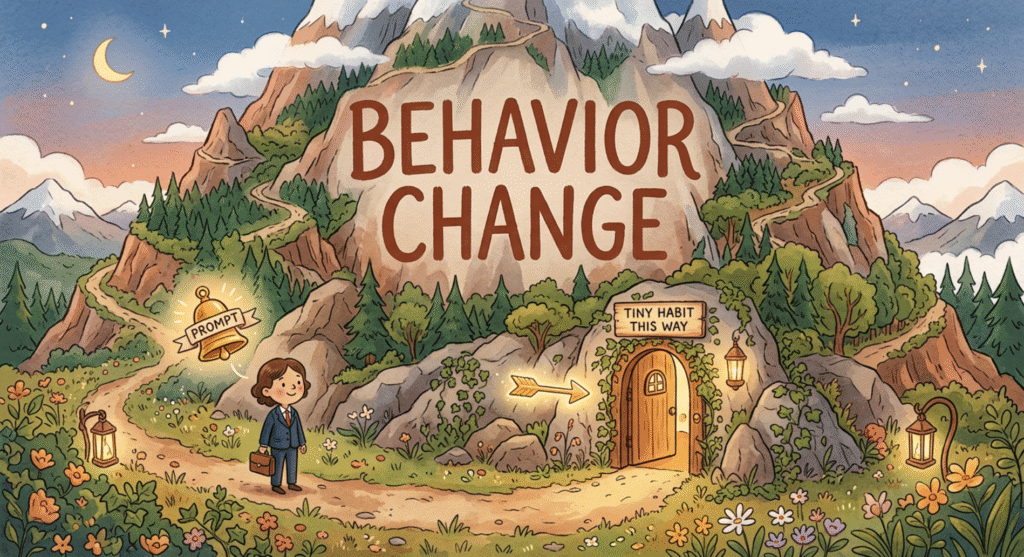
The Information–Action Fallacy is silently killing your sales and L&D initiatives. Here’s how to fix it with behavior design
Here’s a scenario that probably feels familiar.
You invested in a new sales methodology. Built a comprehensive onboarding program. Ran the all-hands to roll out the updated go-to-market. Created the playbook, held the training, shared the deck — maybe even hired someone to make it look good.
Six months later? Your reps are back to their old habits. Pipeline reviews are still a mess. Your commercial team is still leading with price. Before you commission another training program, consider this: the problem was never what your people knew. It was how their environment was designed.
The Fallacy Hiding in Plain Sight
Stanford behavioral scientist BJ Fogg has a name for the assumption baked into nearly every corporate L&D and sales enablement program ever built: the Information–Action Fallacy.
The logic goes: give people better information → they develop better attitudes → better attitudes produce better behavior.
Sounds reasonable. Rarely works.
Decades of behavioral research say information is one of the weakest levers for changing what people do day-to-day. And yet, most enablement strategies — onboarding modules, certification programs, culture decks, strategy memos, leadership workshops — are designed as though the content is the intervention.
The result is predictable: organizations pour resources into communication and content while the specific behaviors they need stay stubbornly, expensively unchanged.
A Better Model — B = MAP
Fogg’s Behavior Model cuts through the noise. A behavior happens — and only happens — when three things come together at the exact same moment:
- Motivation: Does the person want to do this right now?
- Ability: Can they do it easily, without burning time or mental energy?
- Prompt: Is there something in their environment cuing them to act at the right moment?
Miss any one of these, and the behavior doesn’t happen. Full stop. Doesn’t matter how polished the deck was, how clear the expectation was, or how many times leadership reinforced the message.
This is why your playbook is collecting digital dust. Why your reps completed certification and immediately went back to pitching product features. Why managers promised to coach more and never did.
They weren’t ignoring you. The environment wasn’t built for them to succeed.
For Sales Leaders: A Real-World Walk-Through
Imagine you’ve just rolled out a value-based selling approach. Training happened. There’s a talk track. CRM has a shiny new “value hypothesis” field.
Now run it through MAP:
Motivation: The rep already has a pitch that works — sort of. It’s familiar, it’s faster, and their manager has historically rewarded activity and volume, not the quality of discovery. The social math says: stick with what you know.
Ability: This new approach asks them to ask questions they’ve never practiced under real deal pressure, synthesize customer context quickly, and resist the urge to demo early. That’s genuinely hard. Friction always wins when motivation isn’t sky-high.
Prompt: There’s no cue in their actual workflow — no pre-call checklist, no coaching question from their manager before they dial, nothing in the CRM that triggers the new behavior at the moment it matters most.
So, they default. Not because the training failed. Because the architecture around the behavior was never built.
The fix isn’t remedial training. It’s diagnosing which element of MAP is weakest — and redesigning that one thing specifically.
For L&D Professionals: A New Set of Design Questions
Before you build a single module, sit with these:
- Motivation: What does the learner gain immediately from doing this differently? Can they see the payoff within days, not quarters? And critically — have you reduced the social risk of trying something new and imperfect in front of their manager and peers?
- Ability: What’s the smallest version of this behavior a genuinely busy person could do today? Where have you eliminated unnecessary steps, decision points, and blank templates? Are you asking them to perform under pressure without enough deliberate practice first?
- Prompt: Where in their actual workday does this behavior naturally belong? What cue exists at that exact moment — and if there isn’t one, what will you build?
Fogg’s most counterintuitive design principle: when motivation is hard to move, make the behavior smaller instead. Shrink it until it’s almost effortless. A 2-minute pre-call prep habit outlasts a 4-hour certification every single time — because it lives in the workflow, not in a learning portal.
This is the same instinct behind Cathy Moore’s Action Mapping: start with the specific action you need to change, not the information you want to transfer. Knowledge is not the destination. Behavior is.
The Double Loop Diagnostic
At Double Loop Performance, MAP functions as a front-end diagnostic — something we run before any engagement reaches solution design.
When a client says their team “isn’t adopting the new sales process,” the first question isn’t what training do they need. It’s which specific behavior, at which specific moment, is breaking down — and why.
Motivation gap? Ability gap? Missing prompt? Each has a different fix. Treating them the same is how you end up running the same workshop two years in a row and wondering why the needle didn’t move.
The toughest part of this work is almost always structural. The behaviors you’re trying to change have deep environmental support: a comp plan that rewards the wrong activity, a manager whose own habits model the old way, a CRM workflow that makes the right action three clicks harder than the wrong one. Information doesn’t fix any of that. Design does.
Three Moves Worth Making This Quarter
1. Run a MAP audit on your last three change initiatives.
For each one: did you address motivation beyond a compelling presentation? Did you actually reduce the friction of doing the new behavior? Did you put a real-time prompt in the workflow — not in a training manual? Find the gap. Design one specific fix.
2. Make one target behavior tiny.
“Improve discovery conversations” is not a behavior — it’s a hope. “Spend 3 minutes before every first call writing down one customer outcome and one question to test it” is a behavior. It’s completable, visible, and coachable. Start there.
3. Redesign one existing prompt.
Find the closest moment in your team’s natural workflow to when the target behavior would ideally occur. Build a cue there. A checklist field in the CRM. A standing question in the weekly 1:1. A pre-meeting ritual that anchors the habit. No prompt, no behavior — regardless of what anyone learned in training.
None of this is an argument against good content or clear communication. Information has a role. The problem is when it’s cast as the solution — when an org convinces itself that if people just understood better, they’d act differently.
Mostly, they already understand. What’s missing is an environment built to support the behavior you actually need.
That’s the work.
Michael Nagorski is the founder of Double Loop Performance, a growth consulting firm that helps mid-size organizations close the gap between strategy and execution — through sharper sales design, behavior-informed enablement, and facilitation that actually moves teams forward. When organizations find themselves stuck in the loop of knowing but not doing, Michael helps them find their way out.
Contact Double Loop Performance or contact Mike directly through LinkedIn.
References
- Fogg, B.J. Tiny Habits: The Small Changes That Change Everything. Houghton Mifflin Harcourt, 2019. tinyhabits.com
- Fogg, B.J. “Fogg Behavior Model.” Behavior Design Lab, Stanford University. behaviormodel.org
Moore, C. “Action Mapping: A Visual Approach to Training Design.” blog.cathy-moore.com