
By Michael Nagorski, Founding Partner, Double Loop Performance
The sales training budget looks like an investment in people. It isn’t, usually. It’s an investment in content delivery — and content delivery is not the same thing as capability.
U.S. companies spent over $80 billion on training in 2025 — staff payroll plus outside vendors combined.¹ That number has grown for more than a decade. The dominant complaint from sales leaders — that reps go through training and immediately revert to what they were doing before — hasn’t budged. New sales behaviors, on average, fade to near zero within four months of a training event.²
The problem isn’t the content. The problem is the unit of change.
We’re Measuring the Wrong Thing
Sales organizations have gotten precise at measuring individual performance. Pipeline coverage. Close rate. Average deal size. Activity metrics. All tracked, reported, and reviewed at the rep level.
What they haven’t gotten good at measuring is the condition that makes individual performance sustainable: collective capability.
The science of teams makes this plain. A complete picture of sales training ROI requires distinguishing between what an individual does and what the team makes possible.³ Too few sales organizations make that distinction. Performance reviews assess what a rep did. Almost none assesses what the system around that rep produced — or prevented.
The gap has consequences. When teams receive only individual feedback, learning behavior decreases — even in teams with strong structure and clear expectations.⁴ Individual metrics tell reps to look out for themselves. That’s the opposite of what makes skill stick.
Skill Doesn’t Live in Individuals
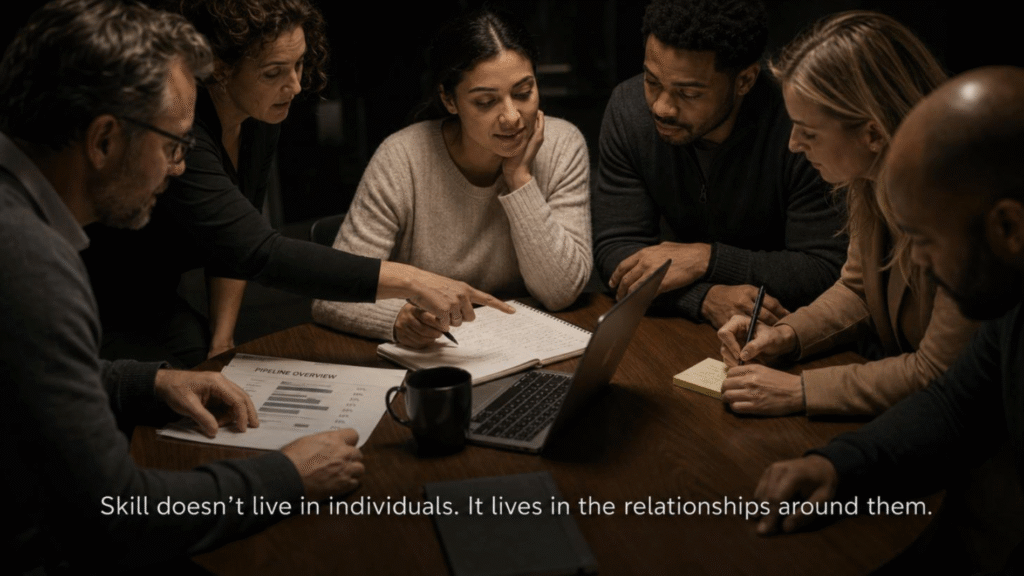
Here’s the frame that changes everything: skill isn’t stored in a person. It’s stored in relationships.
Lave and Wenger’s situated learning theory established this decades ago. Learning isn’t a private mental event — it’s an apprenticeship to the whole community.⁵ Learners develop skill by participating in the practices of the group, not by receiving content in isolation. The model is unambiguous: “much of the learning occurs in the relationships between people, rather than solely as mental activity for the individual learner.”⁵
Sales teams are a community of practice whether anyone designed them that way or not.⁵ What they share — their approach to objection handling, their norms around deal reviews, what a good call sounds like, who people turn to when they’re stuck — that’s the real curriculum. The formal training program is the visible layer. The community is what determines whether anything from that training survives contact with Monday morning.
When the norm is “figure it out yourself,” training fades. When the norm is “we talk about what’s working,” training compounds.
What Looks Like Individual Skill Is Usually a Team Outcome
Watch any high-performing sales rep for thirty days. They’re embedded. They’re running deals with colleagues. They debrief calls in a way that makes the next call different. They have a peer who tells them when they’re losing a deal they think they’re winning.
Take that rep and put them on a team where no one talks, the manager’s job is inspection not coaching, and asking for help signals weakness. The numbers have fallen. Not because the rep changed — because the conditions that made their skill accessible disappeared.
Amy Edmondson’s research makes the mechanism explicit. In a study of 51 work teams, she found that psychological safety — the shared belief that it’s safe to take interpersonal risks — is the precondition for team learning behavior, and team learning behavior is what produces performance.⁶ The unit of safety is the team. The benefit flows to every individual on it.
Skill building happens with relationships. Not in a vacuum. Not in a seminar room. In the accumulated trust and practice of a group of people who have learned how to learn together.
Before You Buy the Training, Look at the Conditions
This is where most sales organizations miss the turn.
Insight Selling documents the failure pattern clearly: training stalls because organizations don’t build the reinforcement systems that transfer learning to on-the-job behavior.⁷ Six of the seven most common failure modes involve conditions external to the training itself — manager behavior, process integration, accountability structures. The content isn’t the problem. The container is.
The question before “what should we train?” is “what does this team actually look like right now?” That’s a diagnostic question, not a content question. It almost never gets asked.
Before any learning objective gets written, it’s worth examining what the team’s actual norms are. Whether deal reviews are learning events or performance judgments. Whether the manager’s behavior after training reinforces what was practiced in the room. Whether reps feel safe enough to say “I don’t know how to close this one” without risking their standing on the team.
Three conditions determine whether any training investment will sustain:
- Decision fidelity — does the leadership team reach genuine alignment, or produce the appearance of it? Low decision fidelity means the sales strategy gets relitigated every quarter.
- Reflection infrastructure — does the organization have a structured practice for learning between cycles? Without it, each training event starts from zero. No accumulation. No compounding.
- Problem definition depth — how thoroughly is the problem understood before the solution work begins? Most organizations keep buying solutions to the wrong problem.
RENDER, DLP’s organizational diagnostic, maps all three — and tells you exactly where to focus before any change initiative begins.
The Implication for How We Design This Work
Training that works isn’t an event. It’s a change to how the team operates.
That means the starting question isn’t “what content do we need?” It’s “what do we find when we look honestly at this team right now?” Run the diagnostic. Understand the conditions. Know what’s on the ground before committing the budget. Then design the training — and the reinforcement — around what you found.
A team that knows what it would do to support a rep who’s struggling — and does it — is a system with faith built in. The rep doesn’t have to carry everything. The system carries some of it. And when the system is doing its job, what looks like an individual decision to push through a hard conversation or try a new technique is something else entirely.
It’s the collective capability, made visible.
If this reframe lands, the next step is the diagnostic.
RENDER Exposure is free — 10 to 15 minutes, automated output, no sales call required. It produces a condition score across all three dimensions and a specific recommendation for where to focus first.
About The Author
Michael Nagorski is the Founding Partner of Double Loop Performance, an organizational development and leadership consulting practice based in Newark, Delaware. He works with executive teams, change leaders, and facilitators who are tired of talking about the right things and ready to actually do them.
Michael has spent more than 15 years helping organizations at inflection points — when they need to move differently without losing what made them good. That has ranged from designing decision-making frameworks for Fortune 500 sales organizations to building facilitation systems for senior leadership teams navigating strategy execution, technology adoption, and culture change.
His work lives at the intersection of facilitation design, behavioral science, and organizational accountability — with a strong bias toward the practical over the theoretical.
He holds graduate degrees from the University of Delaware in Organizational Development and Change and Business Administration, and is the developer of the MEET Funnel methodology for structured decision facilitation.
Contact Double Loop Performance or contact Mike directly through LinkedIn.
Sources
- Statista — U.S. Corporate Training Expenditure: https://www.statista.com/statistics/738399/corporate-training-expenditures-usa/
- ES Research Group — Sales Training Effectiveness Research: https://www.esresearchgroup.com/
- Wiley Blackwell Handbook on the Psychology of Team Working and Performance: https://www.wiley.com/en-us/The+Wiley+Blackwell+Handbook+of+the+Psychology+of+Team+Working+and+Performance-p-9781119673897
- DeShon, R.P. et al. (2004). A multiple-goal, multilevel model of feedback effects on the regulation of individual and team performance. Journal of Applied Psychology. https://psycnet.apa.org/record/2004-21169-011
- Lave, J. & Wenger, E. (1991). Situated Learning: Legitimate Peripheral Participation. Cambridge University Press: https://www.cambridge.org/core/books/situated-learning/6915ABD21C8E4619F750A4D4ACA616CD
- Edmondson, A. (1999). Psychological Safety and Learning Behavior in Work Teams. Administrative Science Quarterly: https://journals.sagepub.com/doi/10.2307/2666999
- Schultz, M. & Doerr, J. (2014). Insight Selling. Wiley: https://www.wiley.com/en-us/Insight+Selling-p-9781118875063