
By Michael Nagorski, Founding Partner, Double Loop Performance
There’s a meeting happening right now in your organization.
It might be called a strategy session. Or a steering committee. Or a “check-in on the initiative.” Whatever it’s named, you know exactly what it is: the same room, the same faces, the same problems on the whiteboard that were there six weeks ago.
Someone pulls up the updated data. Someone else mentions the consultant’s report. A third person asks whether anyone has looked at what a comparable company did. The conversation goes wide. It goes deep. It generates three more sub-discussions that probably need their own meetings.
And then it ends.
Not with a decision. With an action item — someone will gather more information.
If this sounds familiar, you are not watching a people problem. You are watching what happens when smart, capable, high-performing leaders have been handed more information than any human brain was designed to process — with no structure for what to actually do with it.
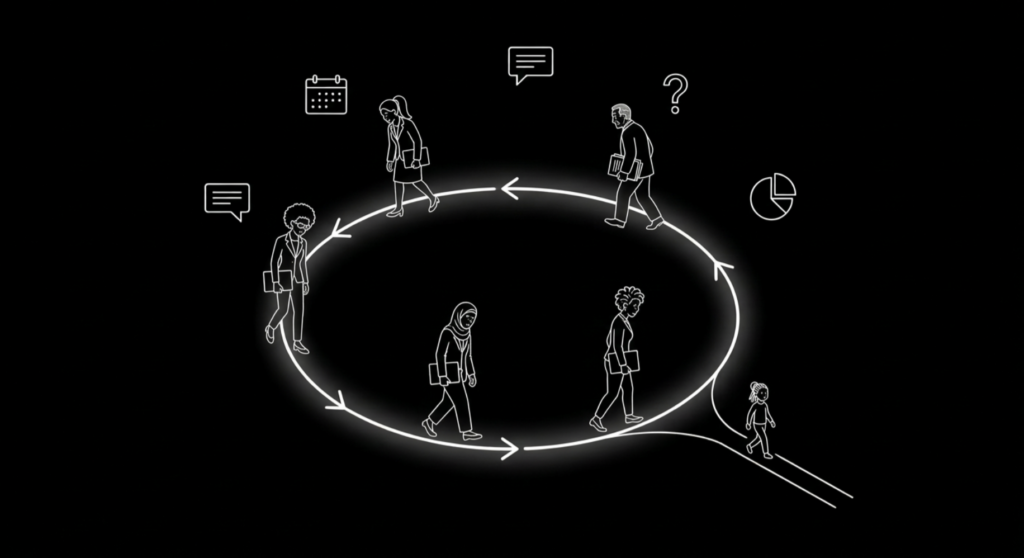
This is the loop. And it is costing your organization more than you think.
The Data Is Telling a Story Most Leaders Won’t Say Out Loud
The numbers here aren’t theoretical. They describe what is happening right now, across organizations exactly like yours.
85% of business leaders have experienced what researchers call “decision distress” — regretting, questioning, or feeling guilty about decisions made in the past year (Oracle, The Decision Dilemma, 2023). 72% say the sheer volume of information has stopped them from making decisions at all. Not slowed them. Stopped them.
At the same time, 91% of leaders say the number of decisions they face every day has increased tenfold over the last three years — while 90% report being bombarded with more data from more sources than ever before.
We have more information, more meetings, and more tools for sharing both — and we are making fewer decisions.
The average professional now spends 23 hours a week in meetings (Microsoft Work Trend Index, 2025). 67% of executives say their meetings fail to produce clear decisions. 71% describe meetings as unproductive. Knowledge workers are interrupted every two minutes during the workday — 275 times per day. Half of all meetings happen during the hours when people do their best thinking.
The loop isn’t a metaphor. It is the operational reality of most leadership teams in 2026.
This Isn’t Laziness. It’s What Overload Actually Does to a Brain.
Here’s what makes this hard to talk about: the loop feels like diligence.
When you schedule another meeting to make sure everyone is aligned, that feels responsible. When you ask for one more round of data before committing to a direction, that feels prudent. When you hold off on the decision until you’ve heard from more stakeholders, that feels inclusive.
None of it is reckless. All of it is reasonable. And collectively, it adds up to nothing moving.
MIT Sloan described this dynamic more than two decades ago as the tension between “paralysis by analysis” and what they called “extinction by instinct” — the manager’s impossible position of being neither reckless nor frozen. The tension hasn’t gotten easier. If anything, the explosion of available information has made the analytical default far more seductive.
What cognitive science tells us is that this isn’t a character flaw — it’s a predictable neurological response. When the brain is overwhelmed by the volume and complexity of incoming information, it stalls. Executive function — the cognitive capacity to plan, initiate, and commit — degrades under load. Decision fatigue sets in. And the easiest available response is to reach for more information, more analysis, more consensus-building. The brain interprets this as making progress. It isn’t.
The Forbes Decision Paradox article from March 2026 describes this precisely: the problem isn’t an absence of data. It’s an overload of decisions compressed into one cognitive space. Leaders believe that if they think harder, read more, connect more dots — the path will become clear. What they don’t realize is that they’ve hit what researchers call the complexity ceiling, where the number of factors involved in a significant decision outstrips any individual’s capacity to integrate them. No amount of additional information gets you past it. Only structure does.
Where You Can See the Loop in the Real World
The research is abstract. The experience isn’t. Here’s where the loop actually lives inside your organization:
In your meetings. The same three agenda items carry over week after week. The loudest voice in the room wins, but nobody commits because nobody trusts the decision-making process that produced the outcome. You leave with new action items that are really just research assignments that will produce material for the next meeting. The cycle is self-reinforcing.
In your strategy sessions. You spend two days in an off-site developing a plan with real ambition. Then you return to the building. The plan sits in a shared drive. A few weeks later, someone says “we should revisit the strategy.” They’re right — not because the strategy was wrong, but because it never generated the structural accountability needed to actually execute it. As Rhett Power writes in Forbes: “Plans aren’t strategies until they generate consistent, measurable action.”
In your change initiatives. An industry-wide figure that doesn’t move: 70% of digital transformations fail to achieve their intended goals. Not most of them — nearly all of them. The evidence points consistently at the same culprit: not the technology, but the adoption. Leaders assume that once people have the information — the training, the rollout, the communications — they will act. They don’t. Because knowing what to do and having the context to commit to doing it are two completely different things.
In your technology rollouts. Gartner’s analysis of 3,100 CIOs found that only 48% of digital initiatives meet or exceed their business outcome targets. Among those that fail, the consistent theme isn’t technical failure — it’s that the humans in the system never got the structural support to make the transition. They got information. They didn’t get a path from information to action.
The Silence You’re Misreading
One of the most dangerous things that happens in leadership meetings is this: the room gets quiet, and the leader interprets that as alignment.
Kathryn Clubb, EVP of Growth and Culture at BTS, puts it plainly in Forbes: “Silence is the biggest execution killer. Leaders often mistake it for alignment, but it’s almost always a symptom of uncertainty or disengagement.”
People go quiet in meetings when they don’t see themselves in the decision. When the process doesn’t give them a real voice. When they’ve learned — from experience, not cynicism — that what gets decided in this room will be relitigated in the hallway conversation after, or in next quarter’s version of the same meeting.
That silence isn’t buy-in. It’s people carrying complexity in their heads because there’s nowhere structural to put it. And complexity carried in heads becomes the meeting after the meeting — the real decision-making forum that happens in the parking lot or on Slack after the calendar invite closes.
Every major organizational initiative has a version of this. The ones that stall usually stall here.
The Real Gap: From Collecting Information to Committing to Action
Here is the structural diagnosis underneath everything described above:
Most leadership meetings are designed to collect information. They are not designed to move through it.
Think about what actually happens in a typical strategy or decision meeting. People come prepared with their piece of the puzzle. They present it. Others respond. Discussion happens — sometimes productive, sometimes circular. Someone summarizes. The meeting ends. If you’re lucky, there’s a parking-lot list. If you’re very lucky, someone sends follow-up notes.
At no point in that sequence did the group do the work of sorting what matters from what doesn’t, generating options worth testing, or committing to a specific owner with a specific next step and a specific timeline.
That work — MAP, EVALUATE, EXPERIMENT, TURN INTO ACTION — is the work that bridges information to execution. And for most teams, it has never been built into the meeting itself.
The MEET Funnel is built on this exact understanding. It isn’t a facilitation trick. It’s a structural response to the fact that meetings fail to produce decisions not because the people in them are disengaged, but because the meeting itself was never designed to get there.
MAP brings the full complexity into the room — not just the things the most vocal person thinks are important, but the hidden problems, the silent concerns, the constraints nobody has said out loud yet. It works because contribution is structured and simultaneous rather than sequential. People stop carrying complexity in their heads and put it somewhere everyone can see it.
EVALUATE does the thing most meetings skip entirely: it narrows. It doesn’t try to solve everything. It surfaces the one or two things that, if you made progress here in the next 90 days, would actually change your trajectory. Anonymous voting removes the HiPPO effect — the highest-paid person’s opinion dominating the room — and produces real signal about what the group actually believes matters most.
EXPERIMENT resists the gravitational pull toward perfection. Most leadership teams, when they finally get to generating options, immediately think in terms of programs, initiatives, and full-scale rollouts. EXPERIMENT pushes toward small, testable actions. What could you run in the next 60 to 90 days that would tell you something real? The goal isn’t a polished plan. It’s a prioritized pathway that a team can actually commit to.
TURN INTO ACTION is where most facilitation frameworks fall apart — and where the MEET Funnel is most distinct. It doesn’t end with a list of priorities. It ends with documented commitments: who owns this, what they will do in the next seven days, who else needs to be in the conversation, and what success looks like. The Impact/Effort matrix isn’t a decoration — it’s a mechanism for forcing the group to look at what’s actually worth moving first, rather than everything being a priority, which is another way of saying nothing is.
Decision Confidence: The Thing Nobody Calls It
There’s a reason meetings devolve into debate, relitigate settled questions, or produce decisions that nobody actually implements. It almost never comes down to the quality of the ideas in the room.
It comes down to decision confidence — and it breaks when three things fail simultaneously.
Voices go unheard. Not because people weren’t invited, but because the meeting format rewards assertiveness over insight. The loudest voice wins. People who hold the most important perspective — the one closest to the actual work, the customer, the operational reality — go quiet because the conversational dynamics don’t make space.
The process is unclear. When people can’t see how decisions are being made — what information is being weighted, why some things are being prioritized over others — they don’t trust the output. They nod in the room and relitigate in the hallway.
Decision rights are ambiguous. Who actually made this call? Who has the authority to move it forward? Who needs to be consulted versus informed? When these questions are unresolved, accountability diffuses. Everyone is kind of responsible. No one is specifically responsible. The initiative stalls because nobody owns the next step clearly enough to take it.
When all three break at once — and in most organizations, they routinely do — the result isn’t just an unproductive meeting. It’s a team that has learned, through repeated experience, that investing effort in the meeting process doesn’t pay off. That calcification is what makes organizations hard to change.
This Is Not a Knowledge Problem
The last thing worth saying here is the one most organizations are slowest to accept:
Your people already know what needs to happen.
They know the initiative is stalled. They know which priorities are actually competing. They know where the blockers are. They have been carrying this knowledge, in many cases, for months or years. Some of them have written it in emails. Some have raised it in one-on-ones. Some have stopped raising it because nothing seemed to happen when they did.
The problem is not that your organization lacks information. You have more information than any leadership team in history.
The problem is that information, by itself, is inert. It does not move unless something moves it.
That something is structure. A designed sequence that takes the complexity everyone is carrying individually and makes it visible collectively. That narrows it to what actually matters. That generates options instead of defending positions. That ends with an owner, a timeline, and a commitment clear enough that someone can be held to it — not in a punitive sense, but in the sense that clarity creates momentum.
The people circling in that image aren’t circling because they’re broken. They’re circling because nobody designed a way out of the loop.
That is entirely fixable.
About The Author
Michael Nagorski is the Founding Partner of Double Loop Performance, an organizational development and leadership consulting practice based in Newark, Delaware. He works with executive teams, change leaders, and facilitators who are tired of talking about the right things and ready to actually do them.
Michael has spent more than 15 years helping organizations at inflection points — when they need to move differently without losing what made them good. That has ranged from designing decision-making frameworks for Fortune 500 sales organizations to building facilitation systems for senior leadership teams navigating strategy execution, technology adoption, and culture change.
His work lives at the intersection of facilitation design, behavioral science, and organizational accountability — with a strong bias toward the practical over the theoretical.
He holds graduate degrees from the University of Delaware in Organizational Development and Change and Business Administration, and is the developer of the MEET Funnel methodology for structured decision facilitation.
Contact Double Loop Performance or contact Mike directly through LinkedIn.
References
- Oracle & Seth Stephens-Davidowitz. The Decision Dilemma (2023). Available at: oracle.com/news/announcement/oracle-ai-report-2023
- Microsoft Work Trend Index Special Report: The Rise of the Infinite Workday (2025). Available at: microsoft.com/en-us/worklab/work-trend-index/breaking-down-infinite-workday
- Bain & Company / Eric Garton. Meeting statistics cited in Harvard Business Review (2017). Available at: hbr.org/2017/07/stop-the-meeting-madness
- Vevox / Rick Gilbert, Speaking Up: Surviving Executive Presentations. 67% of executives cite meetings as unproductive. Available at: vevox.com/blog/67-of-executives-say-their-meetings-are-unproductive
- Gartner Digital CIO Agenda Survey (2024). Only 48% of digital initiatives meet or exceed business outcome targets. Available at: apmdigest.com/gartner-only-48-digital-initiatives
- McKinsey & Company. Digital transformation failure statistics. Available at: mckinsey.com/capabilities/people-and-organizational-performance/our-insights/unlocking-success-in-digital-transformations
- MIT Sloan Management Review. Between “Paralysis by Analysis” and “Extinction by Instinct” (1995). Available at: sloanreview.mit.edu/article/between-paralysis-by-analysis-and-extinction-by-instinct
- Rhett Power. Why Strategy Fails Without Structural Accountability. Forbes (December 28, 2025). Available at: forbes.com/sites/rhettpower/2025/12/28/why-strategy-fails-without-structural-accountability
- Forbes Coaches Council. The Decision Paradox: When More Information Makes Decisions Harder (March 2026). Available at: forbes.com/councils/forbescoachescouncil/2026/03/02/the-decision-paradox
- Daria Rudnik. Decision distress and complexity ceiling research cited in Forbes (2026).
- Jackson, J.M. Managing Information Overload for Senior Leaders in the 21st Century. ProQuest / Walden University (2013). Available at: eric.ed.gov/?id=ED552942
- Nagorski, M. From Debate to Decision: Mastering Collaborative Meeting Facilitation. Double Loop Performance (2026). Available at: doubleloopperformance.com