
By Michael Nagorski, Founding Partner, Double Loop Performance
There’s a moment — if you spend enough time listening to good podcasts — where something clicks in a way that sends you down a rabbit hole. That happened recently while listening to Brené Brown and Adam Grant on The Curiosity Shop, Episode 2. They referenced systems iceberg theory and the idea of thinking down to mental models. The terminology was familiar in concept, but hearing it framed in that conversation sent me digging deeper — specifically into the original research that underpins it.
That research traces back to Dana Meadows, one of the most important systems thinkers of the 20th century. Her book Thinking in Systems is not a business book, but it should be required reading for anyone who works inside organizations and wonders why the same problems keep coming back, no matter how many times they’re addressed.
What I found — and what I want to share here — is that Meadows’ framework isn’t just intellectually interesting. It directly connects to the work we do at Double Loop Performance every day.
The Iceberg Isn’t Just a Metaphor
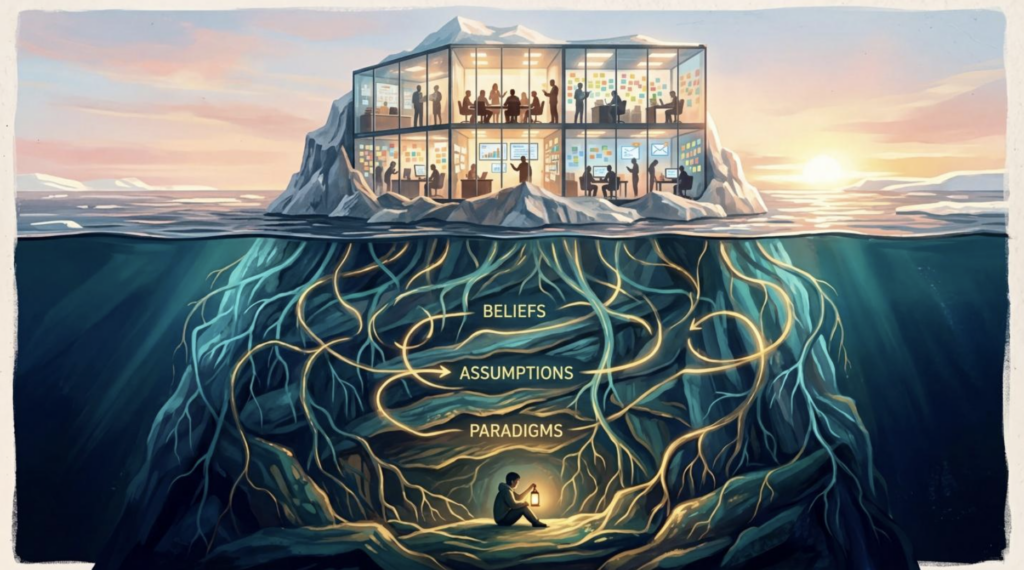
Most people are familiar with the iceberg as a metaphor for the unseen. But Meadows gave it structure. The iceberg model describes four levels of organizational reality:
Events — The visible tip. What happened? The missed deadline. The team conflict. The failed initiative. This is where most organizations focus all their energy, because events are urgent and concrete.
Patterns & Trends — Just below the surface. What keeps happening? If you zoom out, do you see the same types of events repeating over weeks, quarters, or years? Reactive organizations never get here. They’re too busy fighting fires.
Systemic Structures — Deeper still. What’s causing the pattern? These are the processes, incentive systems, reporting structures, and workflows that produce the patterns you see. This is where most change efforts stall — organizations redesign the org chart or tweak the process, but the pattern persists.
Mental Models — The deepest layer. What assumptions, beliefs, and worldviews shape the structures above? Meadows considered this the highest-leverage — and most resisted — place for change. Mental models are the water that all the other fish swim in. They’re invisible precisely because they feel like truth.
The core insight is this: when you only respond to events, you’re playing an endless game of whack-a-mole. You fix the symptom, and the system produces a new one. Sustainable change requires going deeper.
Why Mental Models Are the Hardest Lever
Meadows identified 12 leverage points in a system — places where a small shift can produce large change. Mental models sit near the top of that list, right alongside the power to change the goals of the system itself. But she was also honest: the higher the leverage, the more resistance you’ll encounter.
This isn’t a new observation. Chris Argyris spent decades studying why smart people in organizations resist the very learning that would help them. He distinguished between single-loop learning — adjusting actions when outcomes don’t match expectations — and double-loop learning, which involves questioning the underlying assumptions and beliefs that generated the action in the first place. Sound familiar? It should. It’s the same thing Meadows is describing from a systems perspective.
The deeper you go below the waterline, the more identity and ego get involved. Mental models aren’t just intellectual positions — they’re often tied to how people see themselves as leaders, professionals, and decision-makers. Asking someone to examine their mental model is, in a very real sense, asking them to question themselves.
That’s why it’s uncomfortable. And that’s exactly why it’s important.
This Is What Fearless Leaders Do Differently
The research on psychological safety — Amy Edmondson’s foundational work at Harvard — tells us that teams only surface hidden problems, challenge bad assumptions, and engage in the kind of honest dialogue that leads to real learning when they feel safe to do so. Without that safety, organizations get what they always get: polished presentations, false consensus, and the same problems re-emerging in new forms.
Here’s the connection that doesn’t get made often enough: psychological safety is what creates the conditions to examine mental models. A team that can’t have an honest conversation about what happened (events) certainly can’t have a productive one about why they keep happening (mental models). You can’t skip levels.
This is also where fearful leadership shows up in a concrete way. Leaders who manage through fear — whether they intend to or not — effectively seal the organization below the pattern level. People report events but hide patterns. They blame structures but never examine beliefs. The iceberg stays frozen.
From Theory to Practice: Where the MEET Framework Comes In
Understanding systems theory is one thing. Operationalizing it inside a busy organization is another. That’s where meeting and facilitation design matter more than most leaders realize.
Our MEET Framework — built as a practical guide for how teams come together — is designed specifically to create the conditions for this kind of depth. Meetings that only report on events (what happened this week?) stay above the waterline. The MEET framework pushes teams to ask better questions: What patterns are we seeing? What’s driving those patterns? What assumptions are we holding that we haven’t examined?
This doesn’t require lengthy retreats or expensive consultants. It requires intentional design of the conversations your team is already having. The question isn’t whether you’ll discuss these things — it’s whether the structure of your meeting makes space for them or inadvertently prevents them.
A meeting that creates genuine psychological safety, focuses on learning rather than performance, and surfaces patterns across time is, in effect, a tool for systems thinking in action. The iceberg model becomes less of a theory and more of a diagnostic prompt: Where in the iceberg is this conversation happening?
The Double Loop Connection
The name Double Loop Performance isn’t accidental. Argyris’ concept of double-loop learning — and Meadows’ case for examining mental models — are two expressions of the same fundamental idea: sustainable performance requires questioning the assumptions that generate your current results.
Single-loop organizations get better at executing the same strategy. Double-loop organizations get better at questioning whether it’s the right strategy. Single-loop teams improve their processes. Double-loop teams ask whether those processes are solving the right problem.
This is also the heart of problem reframing, which we write about frequently. Most problems presented in organizational settings are event-level descriptions of pattern-level and structure-level dynamics. Reframing a problem isn’t a rhetorical trick — it’s an attempt to move the conversation to the right level of the iceberg.
What This Looks Like in Practice
Here are a few questions that can help you and your team move below the surface:
- At the pattern level: Is this the first time we’ve seen this? When have we been here before?
- At the structural level: What in our processes, incentives, or design is producing this pattern?
- At the mental model level: What do we believe about how this works? What would we have to believe for this pattern to make sense?
The last question is the hardest — and the most valuable. It tends to surface assumptions that were never explicitly chosen, just absorbed over time. That’s the work. And it’s worth doing.
If you heard the Brené Brown and Adam Grant episode and felt that same click of recognition, you’re not alone. The iceberg is real. And most of what matters is below the waterline.
About The Author
Michael Nagorski is the Founding Partner of Double Loop Performance, an organizational development and leadership consulting practice based in Newark, Delaware. He works with executive teams, change leaders, and facilitators who are tired of talking about the right things and ready to actually do them.
Michael has spent more than 15 years helping organizations at inflection points — when they need to move differently without losing what made them good. That has ranged from designing decision-making frameworks for Fortune 500 sales organizations to building facilitation systems for senior leadership teams navigating strategy execution, technology adoption, and culture change.
His work lives at the intersection of facilitation design, behavioral science, and organizational accountability — with a strong bias toward the practical over the theoretical.
He holds graduate degrees from the University of Delaware in Organizational Development and Change and Business Administration, and is the developer of the MEET Funnel methodology for structured decision facilitation.
Contact Double Loop Performance or contact Mike directly through LinkedIn.