
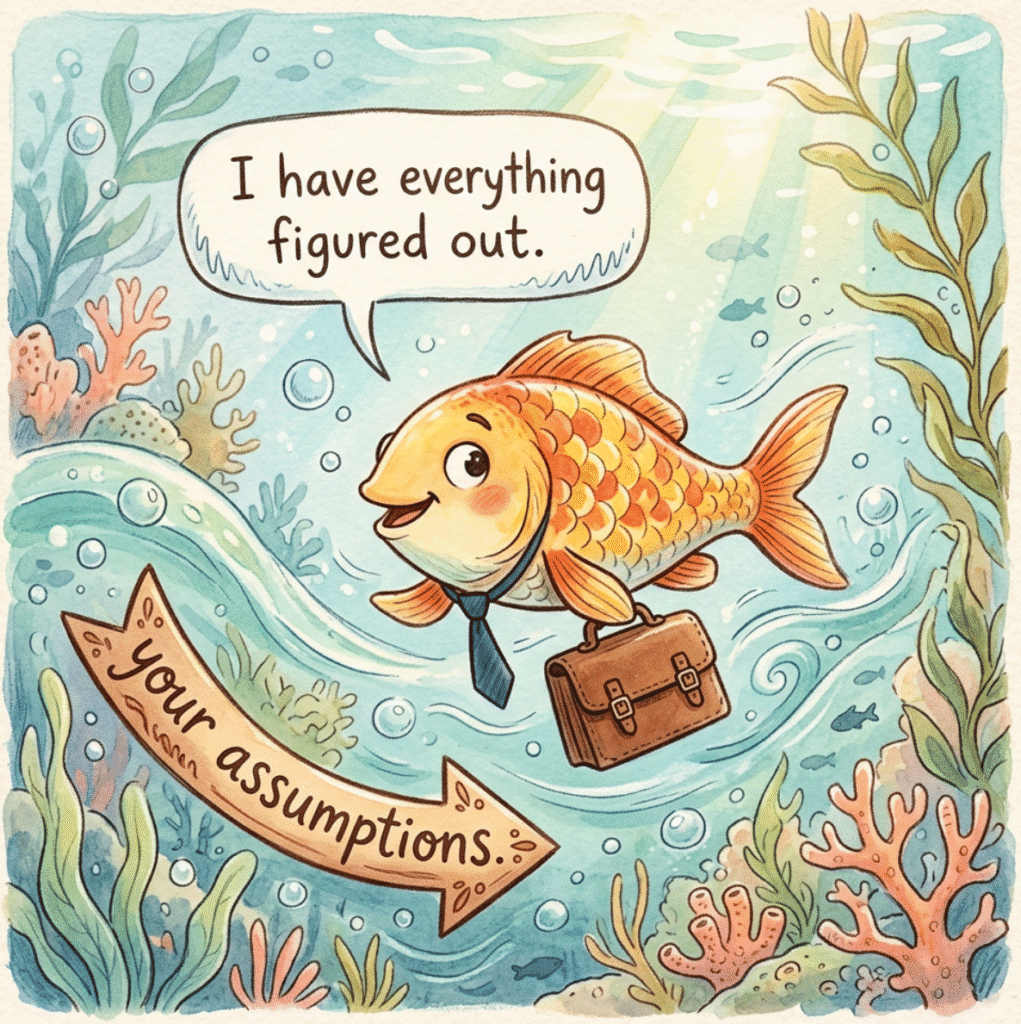
You’ve invested in strategy. You’ve sent your people to trainings. You’ve built dashboards and dashboards of dashboards. And yet — something still feels off.
By Michael Nagorski, Founding Partner, Double Loop Performance
Decisions that should be obvious take too long. Patterns repeat. Smart people keep solving the same problems in slightly different clothes.
The culprit is rarely a knowledge gap. It’s a thinking gap.
You Don’t Know What You Don’t Know — Until You Do
There’s a skill that separates the leaders who keep growing from the ones who plateau. It’s not emotional intelligence, though that helps. It’s not subject-matter expertise, though that matters too. It’s the ability to step outside your own thinking and examine it — in real time, and with honest eyes.
Researchers call this metacognition: knowing about your own knowledge and thinking about your own thinking. It’s the internal operating system behind your decisions, your patterns, and your blind spots.
Here’s why it matters so much right now: most of us were never taught it.
Studies show that rote memorization is the default — and often the only — learning strategy that students carry into adulthood from formal education. College instructors tend to assume their students learned how to monitor and regulate their thinking in high school. Most didn’t. And no one catches the gap, so it follows people into the workplace, into management, and all the way into the C-suite.
The numbers are uncomfortable. Somewhere between 30% and 67% of managers have significant behavioral blind spots that contribute directly to management failures. The average leader carries 3.6 blind spots they cannot see. And leaders who score high on blind-spot assessments consistently receive lower effectiveness ratings from their supervisors, peers, and direct reports — not higher.
Leadership blindness isn’t a personality flaw. It’s a structural gap in how we develop people.

What Metacognition Actually Is (In Plain Language)
Forget the academic term for a moment. Think about the difference between running on autopilot and actually checking in on yourself mid-flight.
Geoff Colvin, in his research on world-class performers, found that the most important skill top performers share is self-observation — the ability to step outside themselves, monitor what is happening in their own minds, and ask how it’s going. Elite runners, for example, don’t tune out during a race. They count their breaths, monitor their effort, and adjust in real time. Most of us, under pressure, do the exact opposite — we go deeper into our heads, not wider around them.
Metacognition works in two stages:
- Metacognitive knowledge — understanding how you actually think, not how you assume you think. What patterns do you default to? What triggers push you toward certain conclusions? What information do you tend to discount?
Metacognitive regulation — the ability to actively adjust those patterns while you’re in the middle of using them. This is where the real leverage is: catching yourself mid-decision, mid-meeting, mid-assumption, and choosing differently.
Most leadership development programs focus on skill-building: better communication, sharper presentations, stronger conflict resolution. These are valuable. But they’re all operating on top of an invisible layer — the mental models that determine when and how those skills actually get deployed. Until you examine that layer, you’re updating the software while the operating system runs unexamined underneath.
Why Organizations Keep Paying for Training That Doesn’t Transfer
Globally, organizations invest an estimated $60 billion annually in leadership development. And yet only 18% of organizations say their leaders are “very effective” at achieving business goals. Three out of four organizations rate their own leadership development programs as “not very effective”.
That’s not a training content problem. That’s a transfer problem.
When people learn a new framework or approach but don’t have the metacognitive capacity to notice when to use it, how to adapt it, and whether it’s working, the learning stays in the classroom. It doesn’t come back to the floor on Monday morning. As one research study put it, “AI doesn’t remove bias — it scales it. Leaders must be able to monitor when they’re outsourcing thinking rather than augmenting it”. The same principle applies to methodology training: without the skill of self-monitoring, frameworks become scripts. And scripted responses don’t respond to the actual situation in front of you.
The Education Endowment Foundation meta-study found that teaching metacognition and self-regulation adds seven months of measurable progress over the course of a year — the highest-impact intervention in their entire dataset. MIT Sloan research showed that soft skills training which incorporated self-reflection components delivered a 250% return on investment within eight months of its conclusion. One McKinsey-documented program that wove brain-skills development and metacognitive coaching into its design delivered an 11.6-fold ROI.
These aren’t soft wins. These are hard numbers from hard-nosed research — and they all point to the same place: the investment most organizations are not making.
The Leadership Blind Spot No One Is Talking About Loudly Enough
Here’s what makes metacognition uniquely difficult: the people who need it most are often the least likely to realize it.
Research shows that leadership blind spots frequently disguise themselves as strengths. The decisive leader who cuts through ambiguity may be missing the moments when ambiguity is actually the point. The empathetic leader who prioritizes team harmony may be avoiding the hard conversation that would transform the team. Patterns that worked brilliantly in one context — and that got rewarded — become defaults in every context. Over time, those defaults calcify.
“When we practice metacognition,” one researcher noted, “leadership becomes less about protecting our strengths and more about noticing when those strengths are limiting us”. That is not a comfortable sentence. But it is an accurate one.
And the downstream effects are real: leadership blindness has been directly linked to higher turnover, lower morale, reduced psychological safety, and greater risk of unethical behavior or counterproductive work practices. These are not soft culture concerns. They are strategic liabilities.
What Thinking About Your Thinking Actually Looks Like in Practice
So, what does metacognitive practice look like for a busy leader — not a monk, not a researcher, not someone with three hours for journaling each morning?
It looks like a few deliberate habits inserted into the work that’s already happening:
- The pause before the pattern. Before defaulting to how you’ve handled a situation before, ask: Is this situation actually the same? What am I assuming?
- The post-action debrief — on the decision, not just the outcome. What informed this choice? What did I dismiss? What would I have needed to see the situation differently?
- The disconfirming question. Deliberately ask for perspectives that challenge your current frame before the decision is final. Not to be indecisive — to be fully informed.
- Naming the mental model out loud. When presenting a direction to your team, briefly articulate why you see it that way. This invites challenge, surfaces assumptions, and models the behavior you want on your team.
This is also where structured approaches pay dividends. Frameworks that build in explicit moments of reflection — articulating what you know, what you’re uncertain about, and what assumptions are driving your interpretation — are not administrative overhead. They are metacognitive scaffolding. They create the conditions where this kind of thinking becomes habitual rather than heroic.
The Organizational Dimension: It’s Not Just Personal
Metacognition isn’t only an individual capacity. It operates at the team and organizational level too.
When teams develop shared metacognitive practices — explicit norms around examining how decisions are being made, not just what decisions are being reached — they navigate complexity more effectively, catch errors earlier, and adapt faster. Research on informal workplace learning found that behaviors like reflection, seeking feedback, and sharing knowledge are strongly tied to metacognitive self-regulation strategies. The organizations that build this into their operating rhythms don’t wait for a crisis to do the post-mortem. They build the post-mortem into the process itself.
This is the distinction between organizations that learn from experience and organizations that repeat it. Between teams that improve across cycles and teams that keep cycling. The former have, either deliberately or by design, built metacognition into the way they work. The latter haven’t.
Why This Is the Investment Worth Making
The research is not ambiguous on this. Organizations that offer effective leadership development at all levels — not just the senior ranks — are in the top 10% of their industry’s financial performance at more than twice the rate of organizations that don’t. The companies that are building leaders who can think about their thinking, catch their own patterns, and recalibrate under pressure are compounding an advantage that is very difficult to replicate.
The school system didn’t build this in. Traditional training often skips it in favor of more tangible content. But the capacity is learnable — at any stage, at any level. The research on adult metacognitive development is unambiguous: when people are made aware of these strategies and given structured opportunities to practice them, they improve. The tools exist. The frameworks exist. The evidence base is well-established.
What’s missing, in most organizations, is the recognition that this is the work — and the commitment to treat it with the seriousness it deserves.
What This Looks Like in Our Work
At Double Loop Performance, the philosophy embedded in our PRESSURE model — Problem, Reflect, Evaluate, Strategize, Sacrifices, Undertake, Reframe, Engage — is not accidental. It is deliberately structured around the metacognitive loop: not just solving a problem, but examining the assumptions that led to it, questioning whether the problem is even correctly framed, and building checkpoints to evaluate whether the approach is working.
Our founding belief is that “change need not be episodic” — it requires “routine testing, questioning assumptions, and monitoring effectiveness of choices”. That’s not a methodology tagline. That’s a description of what metacognitive organizational practice actually looks like at scale.
Our canvases and facilitation frameworks are designed to create the conditions where this kind of thinking becomes embedded in how teams work — not a one-time workshop insight, but a durable operating practice. Because the real competitive advantage isn’t the strategy. It’s the capacity to keep examining, adjusting, and learning from the strategy in motion.
If your organization is investing in leadership and not investing in this, there’s a gap worth looking at. Not with judgment — but with the kind of honest curiosity that, as it turns out, is exactly what metacognition enables.
The glasses were always on the table. We just need to reach for them.
About The Author
Michael Nagorski is the Founding Partner of Double Loop Performance, an organizational development and leadership consulting practice based in Newark, Delaware. He works with executive teams, change leaders, and facilitators who are tired of talking about the right things and ready to actually do them.
Michael has spent more than 15 years helping organizations at inflection points — when they need to move differently without losing what made them good. That has ranged from designing decision-making frameworks for Fortune 500 sales organizations to building facilitation systems for senior leadership teams navigating strategy execution, technology adoption, and culture change.
His work lives at the intersection of facilitation design, behavioral science, and organizational accountability — with a strong bias toward the practical over the theoretical.
He holds graduate degrees from the University of Delaware in Organizational Development and Change and Business Administration, and is the developer of the MEET Funnel methodology for structured decision facilitation.
Contact Double Loop Performance or contact Mike directly through LinkedIn.