

A leader’s guide to buying time without losing ground
By Michael Nagorski, Founding Partner, Double Loop Performance
The Early Signal | Companion Blog Post — “Buying Time When You’re Time Blind” Series
There’s a behavior in organizational life that we tend to skirt in conversation but is organizational malpractice.
Buying time. It’s not lying. It’s not incompetence. It’s the persistent gap between the progress a leader shows and the resolution a problem needs. It shows up in status updates that are technically accurate but strategically incomplete. It lives in transformation timelines that keep extending by a quarter. It hides behind the language of momentum — “we’re close,” “we’re aligned,” “we’re making real headway” — while the root cause sits, intact, underneath.
And in organizations under pressure, it compounds.
The Science Behind the Gap
Before judging the behavior, it helps to understand it.
The brain has a documented tendency to devalue future rewards relative to immediate ones — what researchers call temporal discounting. The cognitive cost of resolving something today always feels higher than the cost of managing it for another few weeks. Research has established a clear link between temporal discounting and procrastination: individuals who heavily devalue future rewards are disproportionately prone to deferring hard work.
Add to this the Planning Fallacy — Kahneman and Tversky’s finding that people systematically underestimate time, cost, and risk while overestimating their experience — and there’s a cognitive environment that makes time-buying feel like a rational response to organizational pressure.
And then there’s Peter Gollwitzer’s research, perhaps the most counterintuitive of all: announcing plans to others creates a “premature sense of completeness” that actually reduces motivation to execute. The social reward of being seen as committed to solving the problem partially substitutes for actually solving it.
Three forces — temporal discounting, the planning fallacy, premature completeness — conspire to make buying time feel like good management. It isn’t. It’s a slow-motion compounding of complexity.
What Time Blindness Has to Do with Leadership
The metaphor of time blindness — drawn from executive function research — is precise. Dr. Russell Barkley’s work describes time blindness as a broken internal stopwatch: the subjective experience of time becomes unreliable when the brain is under load.
In leadership, the same pattern appears without a neurological cause. Priority overload destroys temporal awareness. Activity substitutes for progress. Busyness becomes its own evidence. And because no one in the organization is holding an objective clock — tracking the gap between when a problem was first named and where it stands today — the time-blind leader has no reliable signal that the problem is deepening.
When leaders lose their temporal orientation, the cost doesn’t stay personal. It cascades to the team, the culture, and the organization’s ability to execute.
The Illusion of Progress — and What MEET Exposes
There’s a phrase worth keeping: the illusion of progress. It describes organizations where dashboards are green, activity is high, and updates are frequent — but the underlying problems aren’t getting smaller.
Gallup research found that only 22% of employees believe their leaders know where the organization is headed. That number isn’t a communication problem. It’s a clarity problem. And clarity requires honest reckoning with where an organization is — not just where the leader hopes it’s going.
This is exactly what MEET is designed to surface.
MEET — Map, Evaluate, Experiment, Turn Into Action — is Double Loop Performance’s four-phase facilitation framework for high-stakes meetings. It is grounded in the behavioral science of why group decision-making breaks down: the HiPPO Effect (Highest Paid Person’s Opinion), groupthink, premature convergence, and the collapse of accountability that happens when commitments are assumed rather than structured.
How MEET Works — The Four Phases
M — Map: Bring Complexity Into View
The Map phase externalizes everything — issues, data gaps, competing priorities — through silent, individual contribution before any discussion begins. This single discipline neutralizes authority bias before it starts. No one can see what anyone else is writing. For the first time, the room has a shared view of the real problem space — including the complexity that was being quietly managed around.
E — Evaluate: Sort and Narrow to What Matters Most
Anonymous dot voting against a specific criterion — not a popularity contest, but “which of these would most increase our ability to deliver in the next 90 days?” What makes this powerful: teams are often surprised to discover that the problems generating the most discussion are not the ones generating the most votes. The group’s actual priorities and its stated priorities diverge more than most leaders expect.
E — Experiment: Generate Options Worth Testing
Silent ideation disciplines teams toward small and testable, not large and polished. If the solution requires an enterprise rollout to test, it’s too big. The goal isn’t a program — it’s a signal. This directly counters the planning fallacy by forcing reality tests before full-scale execution. Top-voted experiments get plotted on an Impact/Effort Matrix: Quick Wins, Strategic Bets, Fill-Ins, and Hard Slogs.
T — Turn Into Action: Make Accountability Structural
Every commitment gets an Accountability Card: named owner, first action within seven days, decision authority, and a check-in date scheduled before anyone leaves the room. That check-in date is not ceremonial. It is the most important thing on the card. Without it, the commitment begins decaying the moment people walk out the door.
The MEET Progress Pulse: Accountability Between Sessions
Running a MEET session is not enough on its own. The MEET Progress Pulse is the between-session tool that keeps the work honest. It’s a 20-minute standing check-in — one question per MEET phase — designed for any problem that has been “in progress” more than 30 days.
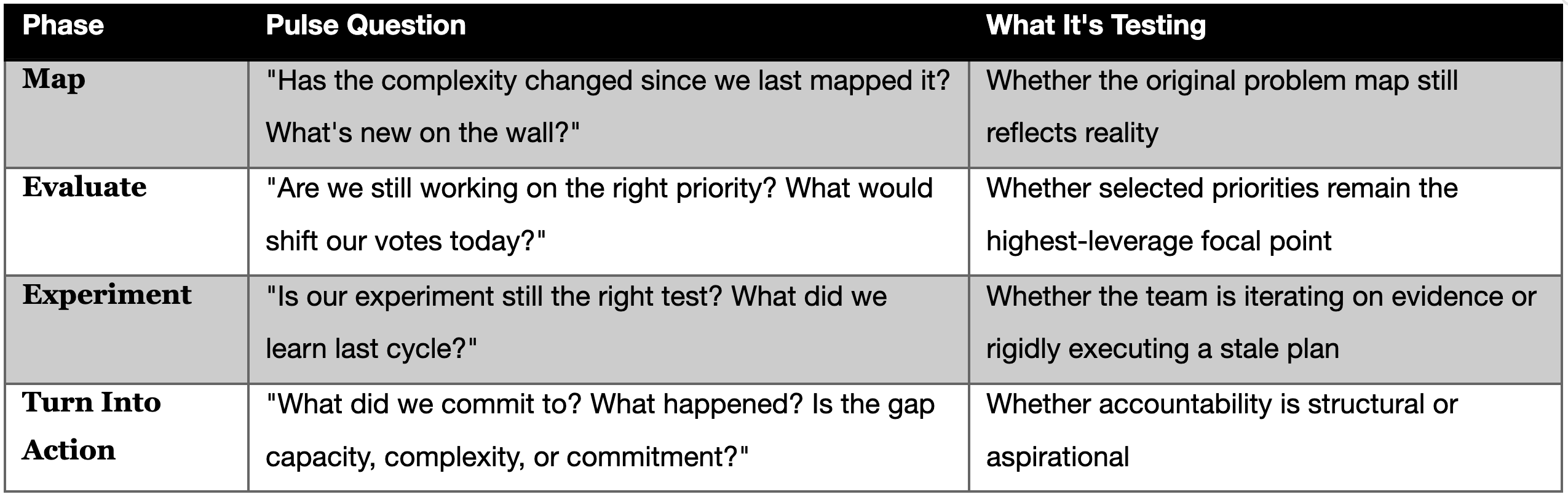
The Pulse is not a status update meeting. It is a learning conversation structured around the four MEET phases. Run it standing. Keep it to 20 minutes. Write down what surfaces. Act on what you hear.
Four Disciplines of the Time Builder
Moving from time buyer to time builder isn’t a single act of resolve. It’s a set of disciplines.
1. Map before you resource.
Require MEET’s Map phase — silent, individual, honest — before solutions are discussed and resources are allocated. What gets funded should be informed by what’s on the wall.
2. Define done before you start.
The Time Horizon Canvas — three columns for Now (0–30 days), Near (31–90 days), and Resolved — forces leaders to define what resolution looks like before activity begins. Without a defined endpoint, any action can look like progress.
3. Run the MEET Progress Pulse.
Use it between sessions to hold priorities, experiments, and commitments honest. The Pulse makes MEET a continuous practice, not a one-time event.
4. Build accountability into the structure.
Commitment devices — public milestones with evidence requirements, external accountability partners, if-then implementation intentions — create binding structures that make following through easier than deferring.
The Leadership Identity That Makes This Sustainable
The final dimension is the hardest, and the one that most leadership development frameworks underinvest in: identity.
MIT Sloan research on leadership visibility is direct: transparency — honest naming of where things are, combined with a clear path forward — now builds more credibility than projecting confidence ever could. The leaders who sustain real progress cultures are not the ones who never buy time. They’re the ones who catch themselves doing it, name it, and course-correct in public.
They create organizations where teams trust them enough to deliver early signals — because those signals are met with curiosity, not defensiveness. And they use MEET not as a meeting format, but as an operating system for honest decision-making at every level of the organization.
The clock is already running. The only question is whether you’re watching it.
This blog post is a companion piece to the four-episode podcast series “Buying Time When You’re Time Blind” on The Early Signal. Each episode goes deeper on the tools and frameworks referenced here — including the Problem Audit, MEET Progress Pulse, Time Horizon Canvas, Early Signal Check-In, Commitment Device, and Time Builder Framework.
Time Builder Framework.Learn more about MEET → doubleloopperformance.com/meet-model
Learn more about the PRESSURE methodology → doubleloopperformance.com/pressure-model
About The Author
Michael Nagorski is the Founding Partner of Double Loop Performance, an organizational development and leadership consulting practice based in Newark, Delaware. He works with executive teams, change leaders, and facilitators who are tired of talking about the right things and ready to actually do them.
Michael has spent more than 15 years helping organizations at inflection points — when they need to move differently without losing what made them good. That has ranged from designing decision-making frameworks for Fortune 500 sales organizations to building facilitation systems for senior leadership teams navigating strategy execution, technology adoption, and culture change.
His work lives at the intersection of facilitation design, behavioral science, and organizational accountability — with a strong bias toward the practical over the theoretical.
He holds graduate degrees from the University of Delaware in Organizational Development and Change and Business Administration, and is the developer of the MEET Funnel methodology for structured decision facilitation.
Contact Double Loop Performance or contact Mike directly through LinkedIn.