
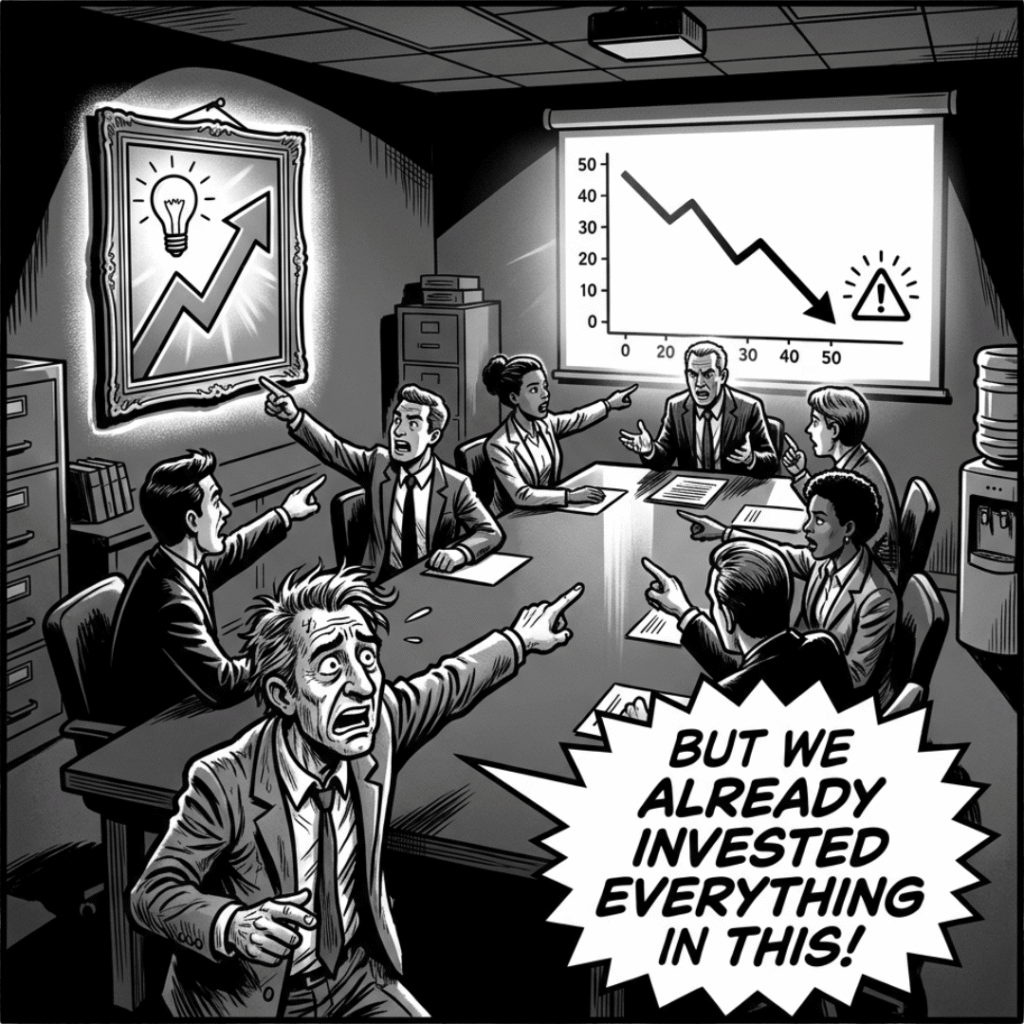
A deep dive into one of the most costly — and most human — traps in decision making.
By Michael Nagorski, Founding Partner, Double Loop Performance
There’s a reason the British and French governments kept funding the Concorde for decades, even as financial projections turned catastrophic. There’s a reason Meta renamed its entire company after a metaverse bet that has since burned through an estimated $70–77 billion. And there’s a reason you’ve sat through the last forty-five minutes of a terrible movie you were already not enjoying — because you’d already paid for the ticket.
The phenomenon has a name: the sunk cost fallacy. And it may be the most expensive cognitive bias in organizational life.
What It Is (And What It Isn’t)
In economics, a sunk cost is simply an investment — of money, time, energy, or emotional capital — that has already been made and cannot be recovered. A sunk cost isn’t inherently a problem. Problems emerge with the sunk cost fallacy: the irrational tendency to continue investing in a failing course of action because of what has already been spent, rather than because of what future investment will yield.
The rational economist’s prescription is clear: past costs are irrelevant to future decisions. What matters is whether the expected value of continuing outweighs the expected value of stopping. Full stop. But humans are not spreadsheets.
Research by psychologists Kahneman and Tversky (Prospect Theory, 1979) identified loss aversion as the engine running beneath this fallacy — we feel the pain of a loss approximately twice as intensely as we feel the pleasure of an equivalent gain. Sunk costs function as psychological losses already sustained. To walk away is to acknowledge the loss. To keep going is to keep the hope of recovery alive, at least in our minds.
The Psychology Underneath
Three interlocking forces make the sunk cost fallacy so stubbornly persistent:
1. Loss Aversion. Stopping feels like losing. Continuing — even wastefully — keeps the possibility of vindication psychologically available.
2. Identity Fusion. The deeper and more publicly we commit to a course of action, the more who we are becomes entangled with what we decided. When a senior leader championed the initiative, when they made the case in front of the board, when their name is on the project — walking away becomes a statement about their judgment, not just the project’s prospects. Research on escalation of commitment, pioneered by Barry Staw, documents this dynamic extensively: the people who made the initial investment are the most likely to double down on it.
3. Cognitive Dissonance Reduction. We are story-making creatures. When the story we’ve told — “this initiative is going to transform our operations” — collides with the reality that it isn’t working, we don’t easily revise the story. Instead, we unconsciously reshape the evidence to fit the narrative. One more sprint. One more quarter. One more pivot. The story survives, for a while.
Studies have also found a troubling moral dimension: when sunk costs are large, people are more willing to accept ethically questionable choices to justify continued investment. The deeper the hole, the more we rationalize digging.
What This Looks Like in Practice
The sunk cost fallacy is not rare, exotic, or confined to obviously failing bets. It hides in plain sight across every industry and function.
- The IT platform nobody uses — but which took three years and $4 million to implement, so the organization continues to mandate usage and adds modules, rather than admit the selection was wrong.
- The strategic hire — a VP brought in with significant fanfare who isn’t performing, but whose performance improvement plan keeps getting extended because of what it would mean to fire them.
- The product in market — showing modest but persistent decline, consuming engineering and marketing resources, but generating enough revenue that killing it feels like failure.
- The training program — designed last year, attended by hundreds, now clearly misaligned with current business challenges, but actively defended because of the design investment.
At an organizational level, research suggests that 70% of mergers fail to create the value projected, 66% of IT projects end in partial or total failure, and IT continuation decisions alone waste $50–150 billion annually in the United States. The Concorde cost British and French governments an estimated $2.8 billion with no possibility of return — and the project ran for thirty years past the point where its commercial viability was clearly in question.
Where It Lives in Workshop and Change Work
If you design workshops, coach leaders, or facilitate decision-making, the sunk cost fallacy is almost certainly in the room with you. You just may not be naming it.
Consider the Choose phase of the 4Cs workshop framework. One of its essential moves — the one that feels uncomfortable almost every time — is the ruthless removal of lower-voted priorities. Ideas that gathered one or no votes get pulled from the board. Discarded. Not put in a “parking lot” to be retrieved later.
That discomfort often isn’t about the idea itself. It’s about the investment already made in it. The person who spent six months building the business case. The team that ran the pilot. The executive who staked their credibility. The move to remove those items from the board is, functionally, a structured disruption of sunk cost thinking — forcing participants to evaluate ideas on forward-looking merit rather than backward-looking investment.Similarly, the Commit phase’s Effort-Impact matrix creates a moment of productive confrontation: where does this actually sit, if we’re honest? High effort, low impact items that have consumed significant past investment suddenly have to justify themselves against clear-eyed criteria. The structure protects against the fallacy by separating the question “how much have we put into this?” from the question “how much does this deserve going forward?”

Five Strategies That Actually Work
Understanding the fallacy intellectually is the easy part. The harder work is building habits and structures that interrupt it in real time.
1. Name It — Explicitly.
When a team is debating whether to continue an initiative and past investment is being used as a reason to press forward, say the words: “I want to flag that we might be experiencing sunk cost thinking here.” Naming the bias reduces its power. Research consistently shows that labeling cognitive biases in the moment helps people separate the emotional pull from the rational analysis.
2. Run a Pre-Mortem Before You’re Too Deep.
Gary Klein’s pre-mortem technique (2007) asks a simple but powerful question at the start of a project or major decision: Imagine it is two years from now and this initiative has completely failed. What happened? This prospective hindsight exercise surfaces risks and assumptions before the investment is made — and before identity and ego have become entangled with outcomes. Running pre-mortems at key project milestones (not just at kickoff) creates a recurring permission structure for honest assessment.
3. Set “Go/No-Go” Criteria in Advance.
Before significant investment begins, define the specific, measurable conditions under which you will stop. Not vague thresholds (“if things aren’t working”) but concrete triggers (“if adoption hasn’t reached 40% by Q3, we reassess the platform”). This moves the decision out of the emotional present and into a pre-committed, rational future. When conditions are met, the conversation changes: it’s no longer about whether to stop; it’s about honoring the criteria you set.
4. Separate the Decision-Maker from the Prior Investor.
Research shows that people who feel personally responsible for a sunk cost are far more likely to compound it. Where possible, bring fresh decision-makers into continuation decisions. Restructure ownership so that continuing versus stopping is evaluated by someone who didn’t champion the original investment. This isn’t about blame — it’s about removing the structural conditions that amplify the fallacy.
5. Reframe the Question.
Instead of asking “should we quit?” — which triggers loss framing — ask “if we were starting fresh today with no prior investment, would we choose this?” or “what do we gain by pivoting?” The reframe doesn’t change the data; it changes the psychological orientation toward it. The goal is to make the forward-looking case attractive, not just logically available.
The Deeper Question Worth Sitting With
The sunk cost fallacy invites us to ask a harder question than “should we continue this project?” It invites us to ask: What are we actually in service of — the investment, or the outcome?
That distinction seems obvious. In practice, it is surprisingly difficult to maintain. The investment is concrete, documented, and emotionally weighted. The outcome is still hypothetical, uncertain, and requires risk. Keeping our orientation on outcomes — especially when that means acknowledging that past choices led us somewhere we didn’t intend — is an ongoing act of organizational and personal courage.
The good news is this: research on the sunk cost fallacy is also research on what it means to be a learning organization. The companies and teams that catch themselves fastest, name it most clearly, and build the structural conditions to interrupt it — pre-mortems, objective criteria, separated ownership — are the same ones that tend to redirect their resources most effectively and maintain long-term competitive advantage.
Walking away from what’s not working isn’t failure. It’s how resources get redirected to what might actually work.
About The Author
Michael Nagorski is the Founding Partner of Double Loop Performance, an organizational development and leadership consulting practice based in Newark, Delaware. He works with executive teams, change leaders, and facilitators who are tired of talking about the right things and ready to actually do them.
Michael has spent more than 15 years helping organizations at inflection points — when they need to move differently without losing what made them good. That has ranged from designing decision-making frameworks for Fortune 500 sales organizations to building facilitation systems for senior leadership teams navigating strategy execution, technology adoption, and culture change.
His work lives at the intersection of facilitation design, behavioral science, and organizational accountability — with a strong bias toward the practical over the theoretical.
He holds graduate degrees from the University of Delaware in Organizational Development and Change and Business Administration, and is the developer of the MEET Funnel methodology for structured decision facilitation.
Contact Double Loop Performance or contact Mike directly through LinkedIn.