
Most meetings fail not because teams lack ideas — but because they lack structure. Introducing MEET: a four-phase facilitation framework that turns group debate into confident, committed decisions.
By Michael Nagorski, Founding Partner, Double Loop Performance
Here’s a scenario that plays out in organizations every day.
A leadership team has a genuinely important conversation. Smart people, real stakes, full calendar invites. Someone walks through a deck. Discussion breaks out. The most senior person in the room makes a case. Others adjust their positions accordingly. By the end, there’s a kind of agreement — a nodding, “good meeting” feeling as people pack up and move on.
Three weeks later, nothing changed.
If that feels familiar, you’re not alone. According to Gartner, 67% of meetings fail to produce clear decisions. Microsoft research puts the average professional’s meeting load at 23 hours per week. And Harvard Business Review reports that 71% of meeting participants find their meetings unproductive.
The instinctive diagnosis is usually one of these: people aren’t engaged, the culture doesn’t support accountability, or the wrong people are in the room. All three may be true. But the deeper diagnosis — the one that’s harder to see — is usually this:
The meeting had no structure for turning participation into decisions.
The Actual Problem: Decision Confidence
Most meeting problems aren’t participation problems. They’re decision confidence problems.
Decision confidence is the degree to which participants leave a meeting believing that what was decided will actually happen — and that they played a meaningful role in getting there.
When decision confidence is low, three things are usually broken:
- Voices were unheard. The loudest voice, the most senior opinion, or the most prepared presenter shaped the direction. Other perspectives existed but never surfaced.
- The process was unclear. People agreed in the room but couldn’t explain how the decision got made. That ambiguity breeds doubt — and doubt breeds the “meeting after the meeting,” where real views finally emerge.
- Decision rights were ambiguous. Nobody was explicitly named as the owner. “We’ll figure out next steps” meant nobody did.
Any one of these is enough to collapse follow-through. When all three are present — which is more common than not — the meeting was theater.
Introducing MEET: A Facilitation Funnel That Makes Decisions Inevitable
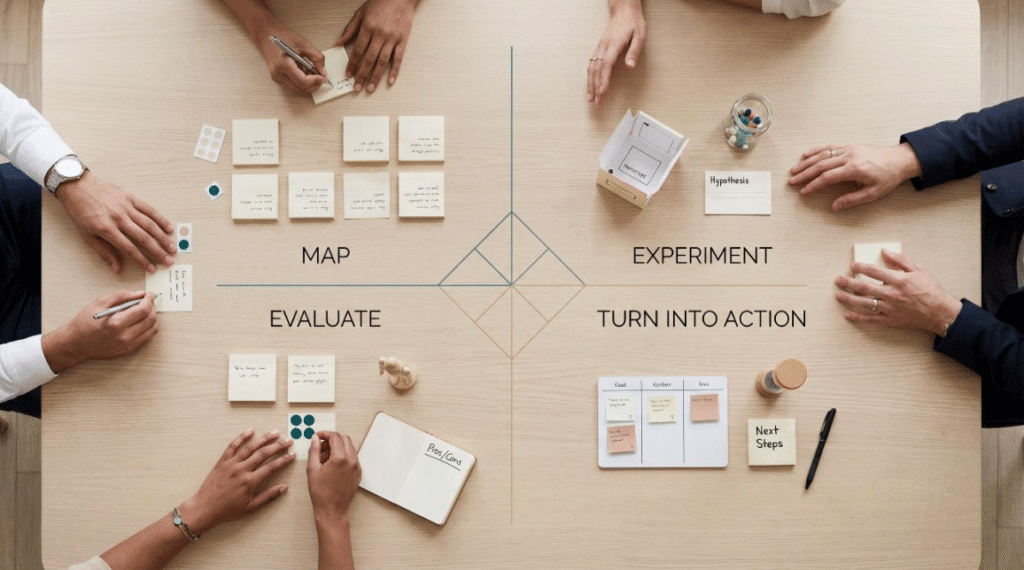
The MEET Model is a four-phase structured facilitation framework developed by Double Loop Performance for exactly these conditions: high-stakes meetings where the cost of ambiguity or inaction is real.
The four phases are:
- M — Map: Bring complexity into view
- E — Evaluate: Sort and narrow to what matters most
- E — Experiment: Generate options worth testing
- T — Turn Into Action: Make accountability structural
Each phase is sequenced intentionally. You can’t evaluate what you haven’t mapped. You shouldn’t generate solutions until you’ve identified the right problem. And you cannot commit to action until you know who holds the authority to move.
Here’s what makes MEET different from a good agenda: it’s grounded in the behavioral science of why group decision-making breaks down.
What’s Actually Breaking Your Meetings (The Science)
Two dynamics sabotage most meetings before the first agenda item is discussed.
The HiPPO Effect. HiPPO stands for Highest Paid Person’s Opinion — the well-documented tendency for groups to defer to the most senior voice in the room, regardless of whether that voice has the best information. Studies on authority bias, dating back to Stanley Milgram’s experiments in the 1960s, consistently show that humans suppress dissent when a high-status opinion enters the room. One study from the Rotterdam School of Management found that projects led by junior managers had higher success rates — precisely because their teams felt safe enough to offer honest critique.
Groupthink. First described by social psychologist Irving Janis, groupthink occurs when the desire for harmony overrides accurate assessment. People see the room moving in a direction and adjust their own stated views — not because they’ve been persuaded, but because the social cost of dissent feels too high.
Both dynamics produce the same outcome: the meeting reflects the views of the most powerful or most confident people, not the collective intelligence of the room.
MEET is engineered around this reality. Every phase has a behavioral countermeasure built in.
The Four Phases, Explained
MAP operates on a principle called together, alone — everyone contributes simultaneously, in writing, before any discussion begins. One idea per sticky note. Silent, individual, parallel. This single discipline neutralizes the HiPPO Effect before it starts. No one can see what anyone else is writing. The quiet analyst and the VP are contributing on equal footing.
What MAP produces is something most meetings never have: a shared, visible map of the full problem space. Issues that would have stayed in heads — the ones we edit out because “this isn’t the right moment to raise it” — get onto the wall. Patterns emerge that no one saw before the map was built.
EVALUATE applies anonymous dot voting against a specific criterion — not “what’s most important?” (a popularity contest) but “which of these would most increase our ability to deliver in the next 90 days?” People cast their votes in silence, independent of what they think the group expects. The group’s collective intelligence surfaces without hierarchy distorting it.
This is the moment where MEET earns its time investment. Teams that have never had a structured prioritization process are often surprised by what the vote reveals: the things that generate the most discussion are often not the things that generate the most votes. The group’s actual priorities and its stated priorities diverge more than most leaders expect.
EXPERIMENT introduces divergent thinking before convergent evaluation. Rather than debating the best solution, participants first generate as many options as possible — silently, independently, with deliberate emphasis on small and testable rather than large and polished. The discipline here is anti-programmatic: if your idea requires an enterprise rollout to test, it’s too big. Start smaller. The goal isn’t a plan — it’s a signal.
Top-voted experiments get plotted on an Impact/Effort Matrix: Quick Wins (high impact, low effort), Strategic Bets (high impact, high effort), Fill-Ins, and Hard Slogs. The matrix forces a conversation grounded in practical reality rather than preference.
TURN INTO ACTION converts experiment into commitment. This is where most facilitation frameworks stop short — they produce great prioritization and then leave accountability to the culture. MEET doesn’t. Every priority action gets an Accountability Card: a named owner (not “the team”), a first concrete step within seven days, the specific decision authority the owner has, and a check-in date that is scheduled before anyone leaves the room.
The check-in date is not ceremonial. It is the most important thing on the card. Without it, the commitment begins decaying the moment people walk out the door.
Where MEET Works
MEET was designed for any high-stakes meeting where the cost of a bad process — or no decision — is real. It’s particularly powerful for:
- Strategy sessions where competing priorities need to be named and owned, not just discussed
- Project kickoffs where scope creep begins with surface agreement on day one
- Quarterly planning where 90-day priorities need to connect to annual strategy
- Budget allocation where advocacy tends to override data
- Organizational design discussions where the people doing the work are often absent from the decision
- Cross-functional alignment where siloed metrics create false disagreement
- Change planning — particularly when the goal is commitment rather than compliance
One insight that consistently surprises organizations using MEET for the first time: the teams that benefit most aren’t the ones with the worst meetings. They’re the high-performing teams whose meetings are functional but not quite leveraging the full intelligence in the room. MEET doesn’t rescue broken teams. It elevates capable ones.
MEET and the PRESSURE Framework
For organizations working through strategic transformation with Double Loop Performance’s PRESSURE methodology — Problem, Reflect, Evaluate, Strategize, Sacrifices, Undertake, Reframe, Engage — MEET is the meeting-level mechanism that operationalizes each phase.
The connection isn’t coincidental. PRESSURE is the macro framework for organizational change: it shapes how an organization diagnoses its challenges, makes decisions about interventions, and builds the capacity to sustain them. MEET is what happens in the rooms where those decisions get made. Without a structured meeting process, even the most rigorous organizational methodology loses momentum to the ordinary dysfunctions of group decision-making.Used together, PRESSURE and MEET address both the what of organizational transformation and the how of the conversations that drive it.
A Final Note on Why Structure Isn’t What People Think It Is
A common objection to structured facilitation is that it feels constraining — like it removes the organic quality of a good conversation. In practice, the opposite is true.
Structure removes the constraint of hierarchy. It removes the constraint of seniority. It removes the invisible pressure to agree with the room rather than say what you actually think.
The best conversations don’t happen in unstructured space — they happen when everyone in the room trusts that the process will give their voice equal standing. MEET is that process.
Double Loop Performance helps organizations unlock sustainable growth through sales strategy, organizational transformation, and structured facilitation. Learn more today!
About The Author
Michael Nagorski is the Founding Partner of Double Loop Performance, an organizational development and leadership consulting practice based in Newark, Delaware. He works with executive teams, change leaders, and facilitators who are tired of talking about the right things and ready to actually do them.
Michael has spent more than 15 years helping organizations at inflection points — when they need to move differently without losing what made them good. That has ranged from designing decision-making frameworks for Fortune 500 sales organizations to building facilitation systems for senior leadership teams navigating strategy execution, technology adoption, and culture change.
His work lives at the intersection of facilitation design, behavioral science, and organizational accountability — with a strong bias toward the practical over the theoretical.
He holds graduate degrees from the University of Delaware in Organizational Development and Change and Business Administration, and is the developer of the MEET Funnel methodology for structured decision facilitation.
Contact Double Loop Performance or contact Mike directly through LinkedIn.